General relativity · Allowed, probably forbidden
A shortcut through the shape of space, if you can hold it open.
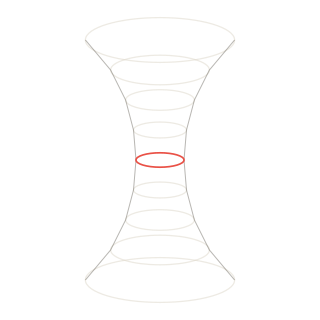
What is a wormhole?
Picture the distance between two galaxies as a long line drawn on a flat sheet. A wormhole is what you get if you fold the sheet over and punch a short tunnel straight through, so two points that were light years apart sit next to each other. The tunnel is a shortcut, not through space, but through the shape of space itself.
This is not only science fiction. Wormholes fall straight out of Einstein's equations for gravity, the same equations that give us black holes. The trouble is keeping one open. The first wormhole anyone found, back in the 1930s, snaps shut so fast that not even light gets through. To hold the throat open you would need a strange kind of matter with negative energy, and nobody knows whether enough of it can exist.
So a wormhole is allowed by the maths, probably forbidden by the physics, and quietly alarming if it is not. Move the two ends around the right way and a wormhole becomes a time machine, which is a large part of why physicists treat them with suspicion. They are also one of the best testing grounds we have for how gravity, energy and cause-and-effect actually fit together.
Do wormholes actually exist?
General relativity does not care about the topology of space. It is happy to let spacetime connect to itself in strange ways, and a wormhole is one of them: a throat joining two regions that can be enormously far apart, or even two different times.
The first example came in 1935. Einstein and Nathan Rosen noticed that the black hole solution could be extended into a bridge linking two separate sheets of spacetime, now called an Einstein-Rosen bridge. It is a genuine wormhole, but a useless one. The bridge is dynamic: it opens and pinches off so fast that anything trying to cross is crushed at the throat before it reaches the far side. You would have to travel faster than light to make it.
In 1988 Kip Thorne and Mike Morris asked the question the other way round. Carl Sagan wanted a believable way to move a character across the galaxy for his novel, so Morris and Thorne wrote down the wormhole they wanted, a throat that stays open with no crushing horizon, and used Einstein's equations to ask what would have to fill it. The metric looks like
\[ ds^2 = -e^{2\Phi(r)}\,dt^2 + \frac{dr^2}{1 - b(r)/r} + r^2\, d\Omega^2 \]
where the shape function \(b(r)\) sets the geometry of the throat and the redshift function \(\Phi(r)\) must stay finite so there is no horizon. When you work out the matter required, the answer is uncomfortable. Holding the throat open means threading it with exotic matter, stuff whose energy density can be measured as negative. Ordinary matter pulls inward and would slam the throat shut. You need something that pushes out.
Negative energy is not pure fantasy. The Casimir effect, two metal plates that attract across a vacuum, produces a tiny region where the energy density really is below zero. The problem is scale. The amount needed to hold open a wormhole you could fly through is staggering, and quantum physics seems to limit how much you can pile up.
Then there is the part that worries everyone. Take a working wormhole, leave one mouth at home, and fly the other around at near light speed. By the same time dilation that ages travelling twins differently, the two mouths fall out of step. Connect them and you can step from the later mouth into the earlier one: a time machine. Stephen Hawking's chronology protection conjecture is the suspicion that nature always intervenes, with quantum fluctuations surging through the throat and destroying it the instant before time travel becomes possible.
The physics of traversable wormholes
The Schwarzschild wormhole
Write the eternal black hole in Kruskal-Szekeres coordinates and the full solution has two exterior regions, a black hole interior, and a time-reversed white hole. A spatial slice connecting the two exteriors is the Einstein-Rosen bridge. It is non-traversable for a sharp reason: the throat is spacelike. To pass from one side to the other you would have to move faster than light, and a timelike observer hits the singularity instead. The bridge exists for an instant and is gone.
The Morris-Thorne conditions
For a static, spherically symmetric traversable wormhole, the throat sits at the minimum radius \(r_0\) where \(b(r_0) = r_0\). Two conditions make it work. There must be no horizon, so \(\Phi(r)\) stays finite everywhere. And the throat must flare outward, which the geometry writes as
\[ \frac{b - b'r}{2b^2} > 0 \quad \text{at } r_0. \]
Feed this back through Einstein's equations and the energy density and radial pressure at the throat violate the null energy condition, \(T_{\mu\nu} k^\mu k^\nu \ge 0\) for every null vector \(k^\mu\). Violating that condition is the precise, coordinate-independent meaning of needing exotic matter. It is not a quirk of one solution. Any traversable wormhole demands it.
How much, and for how long
Quantum field theory does allow negative energy, but not freely. The Ford-Roman quantum inequalities bound the product of how negative the energy density gets and how long you can sustain it. Applied to wormholes, they force either an implausibly large amount of exotic matter or a throat threaded with an exotic layer so thin it strains belief. This is the quantitative reason traversable wormholes look physically marginal rather than merely undiscovered.
Causality
The Morris-Thorne-Yurtsever construction turns the two-mouth time difference into closed timelike curves, paths through spacetime that loop back to their own past. The boundary beyond which they appear is a Cauchy horizon, and as it forms the renormalized stress-energy of the quantum vacuum is expected to diverge and feed back on the geometry. That is the technical content of chronology protection, though a full proof waits on a theory of quantum gravity.
Entanglement and geometry
The most striking modern turn is ER = EPR, proposed by Maldacena and Susskind in 2013: the conjecture that two entangled systems are joined by a wormhole, a non-traversable Einstein-Rosen bridge, so that quantum entanglement and spacetime geometry become two descriptions of the same thing. Building on it, Gao, Jafferis and Wall showed in 2017 that directly coupling the two ends of such a wormhole injects negative null energy and makes it briefly traversable, without ever beating a signal sent the ordinary way, so causality survives. In 2022 a group ran a sparse, wormhole-like quantum model on a Google processor and reproduced the expected teleportation dynamics. It is worth being precise about what that was: a simulation of the holographic dynamics on a quantum computer, not the manufacture of a hole in spacetime, and its framing drew sharp criticism. The shape on screen above is the embedding diagram of the spatial throat, the same surface Thorne's team computed, frame by frame, for the wormhole in Interstellar.
Next: Black Holes & the Event Horizon · or go back to all topics.